Chronic Traumatic Encephalopathy (CTE) is the name researchers have given to the pathological changes associated with repeated blows to the head, e.g. those from playing in the National Football League. In the news today are the results of a post-mortem analysis of 26 year-old Chris Henry's brain. Henry, who died in what was deemed an accident -- falling out of a moving pick-up truck during a domestic dispute, was said to have the tangles and plaques deemed pathognomonic for CTE. At some point, the NFL will properly explore this and more fully fund research into it. Until then, the Super Bowls and Sunday NFL marathons will continue. You know, the band kept playing on the Titanic too.
[Also, I'd be curious as to what the brains of other football (a.k.a. "soccer") players look like. "Headers" don't seem like benign meetings of the cranium and ball to me...something my mother worried mightily about when my sisters and I used to play organized soccer in our youth.]
Monday, June 28, 2010

Thursday, June 24, 2010
Alzheimer’s and the NYTimes revisited
Chuck C highlighted a NYTimes article about familial Alzheimer’s Disease (AD). Today I read a NYTimes article about the use of PET probes to identify AD.
Familial AD has guided current thinking re. the pathophysiology of AD: i.e. the role of amyloid plaques. The three genes implicated are amyloid precursor protein (APP) and presenilin 1 and 2. It is hypothesized that amyloid beta proteins (in particular aβ42) aggregate – and to make a long and complicated and continuously changing story short – cause inflammation and havoc that results in neuron loss. The cortical and subcortical neuron loss manifests as cognitive impairment and dementia, which are the basis for the clinical diagnosis.
Clinical diagnoses are imperfect. The push for markers is strong and lucrative. The NYTimes article that I mentioned earlier highlights the work of Daniel Skovronsky (who is an MD, PhD in industry) and the development of a F18 PET probe targeted against amyloid plaques. In short, the probe identified amyloid plaques that were confirmed in post-mortem autopsies. The work is a technical advancement over the prior C11 amyloid probe. I don’t know the probe’s sensitivity or specificity. And remember that the gold standard is a post-mortem autopsy staining for amyloid plaques.
Amyloid plaques may not be the whole story, though. Transgenic mice that express “abundant” amyloid plaques did not show a strong correlation with neuron loss, in particular the hippocampus. Individuals vaccinated against aβ42 cleared amyloid plaques, but the effects did not protect against neurodegeneration. Other hypothesized processes include i) hyper-phosphorylated tau mediating the formation of neurofibrillary tangles, ii) a decrease in acetylcholine synthesis, and iii) the loss of locus ceruleus neurons that synthesize norepinephrine. The complicated picture correlates with the current understanding of most AD cases, which are sporadic. Out of the many genes screened for associations with sporadic AD, APOE4 is the strongest risk factor. There are probably many more unknown protective and risk factors.
Skovronsky’s probe and other probes (including the ones tested here at UCLA) are baby steps in the right direction. Non-invasive, laboratory diagnostic tests are the holy grail of neurological and psychiatric diseases. And besides their diagnostic applications, in-vivo imagining has the potential to delineate amyloid and tau’s contributions toward the pathology and progression of AD. The NYTimes article states that “20 percent of people over 60 with normal memories had plaque”; these patients “were still statistically in the normal range,” and they “did worse on every memory test than the control group.” What does this mean? I smell longer studies.
But even more lucrative than diagnostic tests are pharmacological treatments. Acetylcholine esterase inhibitors (e.g. donepezil) and NMDA agonists (e.g. memantine) are symptomatic treatments only. I imagine pharmaceuticals have been salivating for some time… Meanwhile, the basic science must continue! Here is some bed-time reading.
Why Medicine?
It is personal statement season, and 2011 med school applicants are faced with the daunting task of answering the question, "Why do you want to go to medical school?"
Tough question to answer in 5300 characters or fewer. Not sure I ever wrote a good personal statement, or that I could in the future. Two years from now I will have to, for residency.
Something to look forward to.
And then there's always the wisdom of this guy, talking to graduates at Stanford recently. If you acknowledge that the practice of medicine needs to, and is, changing, maybe the field is for you. Or maybe it is not.
Tough question to answer in 5300 characters or fewer. Not sure I ever wrote a good personal statement, or that I could in the future. Two years from now I will have to, for residency.
Something to look forward to.
And then there's always the wisdom of this guy, talking to graduates at Stanford recently. If you acknowledge that the practice of medicine needs to, and is, changing, maybe the field is for you. Or maybe it is not.
Wednesday, June 23, 2010
Tuesday, June 22, 2010
A health plan, 2 bucks a year
I'm not passing judgment one way or another about Rwanda's national health plan, but it strikes me as a positive start and model for health care in developing African nations. It's interesting how some basic and dirt cheap measures are apparently improving outcomes for Rwandans...
Monday, June 07, 2010
When the “Step One Adventure” (SOA) began...
... I considered posting updates, which sounded like a good idea, i.e. until I realized that most of my writing would be filled with angst and more angst. A little time has provided an emotional buffer, and I feel a somewhat comfortable providing commentary.
If you’ve taken SO, you know what I am talking about. If you plan on taking SO, you will soon. For everyone else, don’t worry: you aren’t missing out. Here are the cliff notes.
In a tiny little carrel on the eight floor of a building called “the Stacks,” I spent most of my day reading through “First Aid,” “BRS Pathology,” and “Rapid Review Pathology,” while doing USMLE World questions. Midway through my studying, I fled the stacks for my parent’s home. I drank better coffee, ate home-cooked meals, finished a first pass of the material, and started to make some headway on the Q-bank. When I returned to West LA, I avoided the stacks. My room became my cave. The days were spent hunched-over in front my computer, doing questions, questions, and more questions until I developed UWorld-burnout to go along with First-Aid-burnout. I tweak my back from poor posture; I developed a mild fungal infection on my left elbow. At this point my body hated me and I was ready to get the SOA over with.
There were times during the process when evil little thoughts tempted me to postpone my test date. “Anthony, you could do better if you had an extra week.” “Anthony, there is so much more high yield material to go over.” Now that I’ve taken the exam, I could not imagine the unnecessary suffering I would have put myself through. I accepted the gaps in my knowledge. And as Chuck C told me, I had to “trust the preparation.”
The preparation was both hellish and useful. The experience forced me to work really hard for a substantial amount of time. And while I worked hard, I tried harder to keep sight of the bigger picture: life will go on after the test. The SOA wasn’t fun, but there people out there who are having much less fun all the time. Let’s count our blessings, folks.
Wednesday, June 02, 2010
Alzheimer Disease - "earlyonset" and new therapies
NYTimes has a popular piece about an extended family, ravaged by early-onset (earlyonset) Alzheimer Disease and how a study using vaccines and anti-amyloidogenic medications is attempting to see whether early interventions might affect disease course. Given how difficult the disease has been to treat thus far, I'm not terribly optimistic about the current studies. But in order to get to the promised land of developing treatments that dramatically affect outcomes, sometimes the best researchers can do is continue to soldier on. At the very least, new insights are sure to emerge...
Sunday, May 09, 2010
One year??!
In T-minus one year, I will be finished with my PhD and heading back to the clinical side of things. I got to thinking about this at a BBQ tonight at a collaborator/thesis committee member's house. Several of us graduate students were shooting the research-shit -- how many papers, how long will it take, how little we know.
I will have my PhD in one year's time, but do I really have the mind of a scientist? At this point, I can't help but think how woefully inept I am at planning, executing, analyzing, and proposing scientific studies. Though I've come leaps and bounds about how to think about science (so much of it seems like OBVIOUS common sense, so much else of it seems uncertain and difficult to grasp), I still feel as though I don't know shit. Maybe that means I actually am on the path, and that I've made much progress. Perhaps; time will tell.
I will have my PhD in one year's time, but do I really have the mind of a scientist? At this point, I can't help but think how woefully inept I am at planning, executing, analyzing, and proposing scientific studies. Though I've come leaps and bounds about how to think about science (so much of it seems like OBVIOUS common sense, so much else of it seems uncertain and difficult to grasp), I still feel as though I don't know shit. Maybe that means I actually am on the path, and that I've made much progress. Perhaps; time will tell.
Sunday, April 25, 2010
Failing trials...
Gov't sponsored cancer drug trials are doing it wrong, big time.
To me, this issue is fairly complex and does not just simply boil down to the need for a "better managed and funded" system. It requires a fundamental change in the way drugs are developed, evaluated, and then applied to certain disease states.
To me, this issue is fairly complex and does not just simply boil down to the need for a "better managed and funded" system. It requires a fundamental change in the way drugs are developed, evaluated, and then applied to certain disease states.
Saturday, April 24, 2010
Treating the scars of war
Warrior transition units for members of the U.S. armed services are rife with problems.
Thursday, April 22, 2010
Posting slow-down
I've been slammed by work in the past few days, dealing with many time-sensitive issues (a rarity in research). More posting...and soon.
Saturday, April 17, 2010
Thursday, April 15, 2010
Change we can believe in
President Obama has instructed his HHS secretary, Kathleen Sebelius, to develop rules that enable patients to appoint "visitors" with the same rights and privileges as family members, and hospitals may not go against the will of the patient on the basis of "race, color, national origin, religion, sex, sexual orientation, gender identity, or disability."
It warms me to see our President doing something about an issue that has tormented same-sex couples for as long as they and their partners have been faced with medical issues.
Regardless of how one feels personally about the issue, no one can deny that the patient possesses autonomy in who he or she designates to be the equivalent of "next of kin."
Because to not do this, we are systematically denying patients a fundamental right.
It warms me to see our President doing something about an issue that has tormented same-sex couples for as long as they and their partners have been faced with medical issues.
Regardless of how one feels personally about the issue, no one can deny that the patient possesses autonomy in who he or she designates to be the equivalent of "next of kin."
Because to not do this, we are systematically denying patients a fundamental right.
Wednesday, April 14, 2010
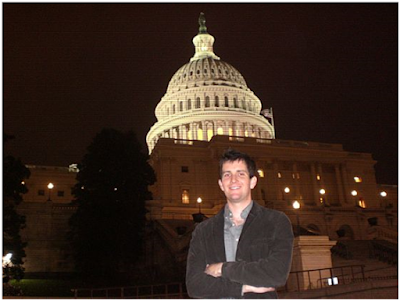
Photo at Capitol, 3-21-2010
As promised, and as much for my own recollection down the road as for anyone's enjoyment at the present, here is photo my sister took of me, just about an hour before the house passed health care reform on 3-21-2010.
Infections persist
Hospital-acquired infections -- and all of the expense, morbidity, and mortality associated with them -- aren't yet under control.
Tuesday, April 13, 2010
A great NYTimes blog to check out
The New Old Age blog on the NYTimes is an outstanding resource, both for persons who care for or have elderly people who are a regular part of their lives AND for anyone going into the medical or related fields. Two recent posts, one on drivers with varying degress of dementia and another on the aging drinker are must-reads.
Agriculture report
Too much of a good thing tends to be problematic. A normal equilibrium is disrupted, and it is difficult to predict what may happen. This is one of the problems with genetically-modified crops, though it's not completely clear-cut. The future of genetic modification in agriculture is very much uncertain, and the benefits and drawbacks are fiercely debated at the present. Read this for more.
On the flip side, there are about 1 billion under-nourished persons on the planet. With lower crop yields in areas particularly susceptible to the effects of climate change, that number promises to increase, perhaps by as much as 230% by 2050, without substantial increases in crop yields elsewhere in the world. Read this for more. (Subscription to Science may be required.)
On the flip side, there are about 1 billion under-nourished persons on the planet. With lower crop yields in areas particularly susceptible to the effects of climate change, that number promises to increase, perhaps by as much as 230% by 2050, without substantial increases in crop yields elsewhere in the world. Read this for more. (Subscription to Science may be required.)
Monday, April 12, 2010
H1N1 - it's all in the structures
A new report published in Science lays out the structural basis (in the antigen hemagglutinin) for the marked similarity between the "Spanish Flu" H1N1 of 1918 and the "Swine Flu" H1N1 of 2009. Most notably, the antibody response to the 1918 strain confers immunity to the 2009, and the structural basis of this is shown in the study. Awesome! (Subscription required to read the full text.)
This week's least surprising story
Let me understand this: researchers who were paid by a pharmaceutical company developing a particular treatment were more likely to report positively on the drug's effects on patients. Shocking. And I'm not saying the relationships/reasons are totally obvious, either. But to me, this is similar to how people who study a particular protein and, say, get the bulk of their grant money for studying that protein, are likely to publish studies stating how important protein x is. I wrote about this back in 2008.
Sunday, April 11, 2010
The road ahead is well traveled
Second year of medical school is nearly over. Finals will be done this Wednesday. Assessment Week will end on April 23. Boards are scheduled for June 4. Wow, how time has flown by.
To celebrate the first two years of medical school, our class hosted a little shindig atop the hills of Westwood, with free booze and food and some speeches. The event was not bitter-sweet. I feel ready to move on. Perhaps the sentiment will change. Maybe not.
Don’t get me wrong: I’ve thoroughly enjoyed my two years in medical school. I could not have asked more from my peers and mentors. I’ve grown in a comfortable environment. While the curriculum was not perfect, it was good. If I had to enter my third year of medical school, I feel like I would be ready. I’m on my way to adult-like responsibilities that are real and serious. Strange.
I don’t know what to expect of graduate school. But I am mentally ready. I am mentally ready to finish the year strong with boards, a break, and research. I’ll take more classes and do more research. I’ll stop taking the classes and continue research until I’ve completed enough to resume MS3. The granular roadmap is in place. Now it is time to fill in the details.
I’m trying not to get ahead of myself. First things first: i.e. 1) study hard through finals and until boards, and 2) stay healthy by a) exercising, b) eating well, c) sleeping, and d) valuing my relationships.
The road ahead is well traveled with a lot of trails. A picture of my path is attached below.

Subscribe to:
Posts (Atom)